March 12, 2026
Analysis
Hezbollah’s Gamble
The war on Iran spreads to Lebanon.
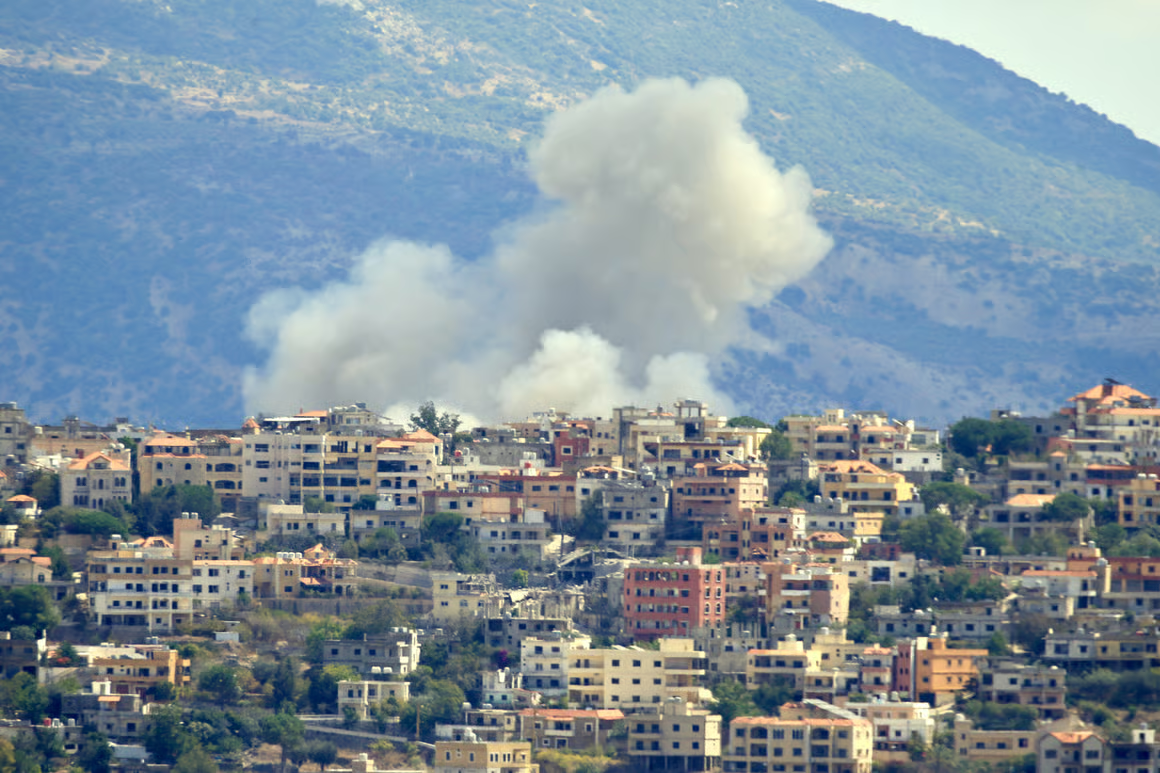
As the United States and Israel launched their criminal assault on Iran, many in the region waited to see how Hezbollah would respond. In the aftermath of its devastating clash with Israel in 2024, the Lebanese party’s capacities were greatly diminished and much of its former leadership was dead. It had signed a heavily one-sided ceasefire deal, brokered by the US, in which it pledged to retreat north of the Litani river and give up its bases in the south, while Israel continued to occupy parts of Lebanon and carried out constant attacks. As the bombs began to fall on Tehran, some doubted whether Hezbollah would be able or willing to reengage the enemy.
Yet Hezbollah had also spent the past year rearming and reorganizing its command structures on the basis that a confrontation of this kind was likely inevitable, and that it needed to reposition itself in the changed landscape of the Middle East. On March 2nd, two days after the start of the war, it opened fire on Israel with a barrage of missiles. Israel responded by issuing evacuation notices to the entirety of south Lebanon as well the southern suburbs of Beirut. An unprecedented 600,000 residents flooded out of the area, while others remained trapped in the zone marked for destruction. The ensuing Israeli airstrikes laid waste to civilian infrastructure, killing almost 500 people and injuring more than 1,300. At this stage there is no telling when the war will end, amid mixed signals from Washington. But whatever the timeline, the return to hostilities in Lebanon could have long-term implications for both Hezbollah and Israel. What is each side hoping to gain?
There is reason to speculate that Hezbollah’s entry to the conflict was preemptive. Over the previous days Israel had mobilized an estimated 100,000 reservists with a heavy concentration at its northern border with Lebanon. According to a leaked US embassy cable dated to the eve of the war, Israel doubted that the Lebanese government would deliver on its promise to disarm Hezbollah—implying, perhaps, that Israel would need to take matters into its own hands. A report from Israel’s Channel 12 claimed that an attack on Lebanon had already been approved before Hezbollah made its move.
Yet whether or not Israel was always planning to expand the war to Lebanon, its calculus is fairly clear: it views the weakening of Iran as a means to eliminate its regional rivals—starting with Hezbollah and then almost certainly proceeding to the Yemeni Ansarullah—and thereby consolidate its position as the Middle East’s undisputed hegemon. In so doing, it may also be able to expand its territory into Lebanon, Syria, and Gaza, in order to offset its relative lack of strategic depth.1Israeli officials have long spoken of Greater Israel as a biblical right and a Zionist aspiration. Setting aside the theological mystification, one of Israel’s primary weaknesses is its lack of a strategic depth. Expanding its territory where possible while destabilizing and controlling the surrounding region are two ways it aims to mitigate this problem. Hezbollah, on the other hand, likely sees Iran’s forceful response to the aggression—fighting tooth-and-nail to preserve its sovereignty—as having created a possibility, however slim, for the party to reestablish its position in south Lebanon and push the Israelis out. If the ceasefire of 2024 risked turning Hezbollah into a marginal and domesticated force, it might now see an opening to reverse these fortunes.
Additionally, Hezbollah may be exploiting an opportunity to put pressure on Israel’s northern front, with Iranian ballistic missiles now straining air defenses across the region and most of the Israeli air force and intelligence agencies focusing their attention on Iran. Hezbollah missile attacks have reportedly caused some damage in the center of Israel and in the northern settlements. The party claimed to have destroyed a satellite communications center, and its coordinated attacks with Iran suggest close coordination between its military wing and the IRGC. The offensive also evinces a strategic shift, with Hezbollah reverting to the guerrilla warfare tactics it used in the 1990s: Israeli military officials report that Hezbollah has deployed small units which have attacked their forces before rapidly disappearing.
The Lebanese government of Nawaf Salam, brought into office on an American mandate to disarm Hezbollah, responded to the crossfire by banning the party’s military activities outright. It condemned Iran’s attacks on the Gulf countries and called for negotiations with the Israelis, affirming that it would discuss “any agenda” in “any format” and “any venue.” Naturally, Salam’s requests were refused and the Trump administration reportedly refused to take his calls. Yet while Hezbollah has so far thwarted the government’s attempts to rein it in, it must still deal with Lebanese public opinion, which is firmly against the decision to rejoin the war. Many feel that Hezbollah has plunged their already fragile country into another ill-fated conflict, either at the behest of the IRGC or to regain control over occupied land in the South, which some among Hezbollah’s political opponents may be increasingly willing to forsake if it means they can avoid further escalation.
There are also risks that internal tensions could breed sectarian strife in Lebanon. With more than half a million Shias displaced across the country, reports of sectarian agitation are becoming ever more frequent. The country’s geographical divisions have widened, as southerners suffering constant Israeli bombardment feel that the government in Beirut has done nothing to protect them. Many of Hezbollah’s supporters, who have yet to recover from the previous round of fighting in which more than 4,000 were killed, are not in favor of this renewed conflict. But because the party remains the only force that could potentially deter Israel from annexing much of their territory, it retains an enduring legitimacy, whatever criticisms its social base might have.
Despite what Hezbollah’s opponents in both Lebanon and the West claim, the party does not view itself as an extension of the IRGC, nor as a pawn in Iranian foreign policy. It is a regional player with its own strategic view and political outlook. Yet it would be wrong to conclude from this that Hezbollah is not an essential element of Iran’s forward defense. The alliance between Iran and Hezbollah is inevitably asymmetrical because the relation between them is necessarily mediated by the logic of Tehran’s national security interests. This remains the case irrespective of the individual relationships between the two sides and their ideological dispositions. Hezbollah, acutely aware of this power imbalance, must carefully weigh its own interests against those of Iran. Its actions since March 2 reflect this complex relationship. They should be understood not only as an attempt to defend Iran, but also as a major, possibly even existential, gamble: a bid to reclaim the party’s legacy following the 2024 defeat, along with the territories occupied by Israel.
Hezbollah is, moreover, trying to reposition itself in the region’s emerging geopolitical order, whose precise contours remain unclear. Having placed an extremely high-stakes bet on Iran successfully deterring the US and Israel, Hezbollah will prove its worth as security partner in the event that the Islamic Republic manages to preserve its sovereignty at the war’s end. If this strategy fails, though—either because the Iranian government falls or because it signs an unfavorable ceasefire deal, which seems to be the resolution that Trump now wants—Hezbollah could find itself newly isolated. It may then have to face the Israeli army as the latter pivots away from Iran and focuses its ire on Lebanon alone. There is no telling how disastrous this outcome might be.
Further Reading

Soy Republics
Corporate concentration and the far right in South America
The region's role as a key soy exporter has empowered reactionary politics and fuelled ecological resistance, in the biome and beyond.
Conscious Uncoupling
Can America's allies bypass the hegemon?
Can America's allies bypass the hegemon?

Transformation without Taxation
Mexico's fiscal orthodoxy
AMLO and Sheinbaum have reorganized political power in Mexico, but they have refused to push through progressive tax reform. Is this balancing act sustainable?